

Stored Product Pests
Tiny beetles and moths in flour, grain, spices and pet food, at home or in bulk storage.
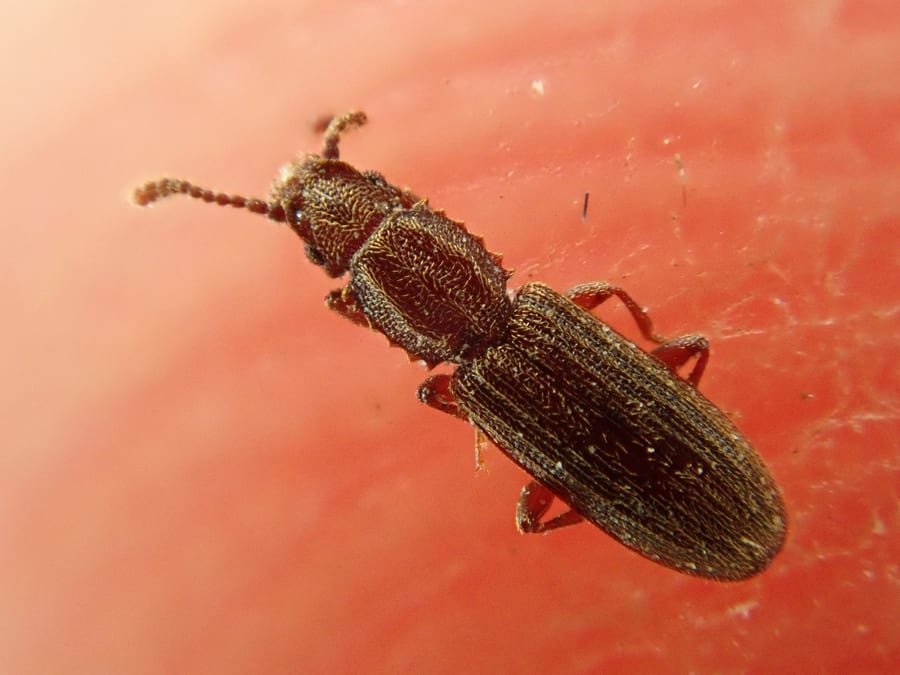
Overview
Stored product pests are the small beetles and moths that live in dry food — flour, grain, cereal, spices, pet food, bird seed and dried goods. In a home they turn up in the pantry. In a commercial setting they show up in bulk dry storage, warehousing, retail back-of-house and restaurant dry storage, where they cause real product loss.
These insects almost always arrive inside a package that was already infested, then spread to nearby containers. The key to control is finding and removing the infested material, because the problem lives in the food, not the room.
How to identify
- Pantry beetles are small brown beetles, only a few millimetres long, found in or around dry-food packages.
- Stored-product moths leave fine webbing and clumping in the surface of flour, grain or seed.
- Larvae are small pale grubs or caterpillars in the food itself.
- Adult insects are often first seen crawling on the pantry shelf or flying near it, away from the food.
Fast facts
- Where
- Pantries, bulk storage, warehouse and retail dry goods
- Common groups
- Pantry beetles and stored-product moths
- Source
- Usually an already-infested package
- Key step
- Find and remove infested material
Signs to watch for
- Small beetles or moths in or near cupboards where dry goods are kept.
- Webbing, clumping or a musty smell in flour, grain, cereal or seed.
- Larvae or shed skins in the bottom of a package or on the shelf.
- Insects appearing in rooms next to the pantry or storage area.
Why it matters
- Infested food has to be thrown out, which adds up quickly in a stocked pantry.
- In bulk storage and warehousing, contamination means product loss and stock that cannot be sold or served.
- Populations spread from one package to the next if the source is not removed.
How we handle it
Our approach
Inspect and trace the source
We check every dry-goods container in the area to find which ones are infested. Why it matters: the infestation lives in specific packages, and it will keep going until those are found.
Remove infested material
Infested food is identified for disposal and removed from the space. Why it matters: no treatment works around a food source that is still breeding insects.
Treat harbourage
We clean and treat the shelving, cracks and voids where insects and eggs collect. Why it matters: some species leave the food to pupate in cracks nearby, so the shelf itself needs attention.
Protect storage going forward
We set up sealed-container storage, stock rotation and monitoring for the pantry or the storage area. Why it matters: keeping new stock sealed and rotated is what stops the next infested package from spreading.
Prevention
Keep them from coming back
- Store dry goods, pet food and bird seed in sealed hard containers.
- Rotate stock and use older packages first.
- Check bulk and bulk-barn purchases before adding them to storage.
- Vacuum pantry shelves and cracks regularly.
- Keep an eye on rarely used items like specialty flours and decorative grain.
Questions
Stored Product Pests questions, answered
I found beetles in my flour. Is the whole pantry infested?
Possibly, since these insects spread between packages. Everything needs to be checked, infested items thrown out, and the shelves vacuumed and treated. Once the infested material is gone and goods are stored in sealed containers, the problem usually ends there.
How did they get in?
Almost always inside a package that was already infested when it came home or arrived at the warehouse. From there the insects move to nearby containers.
Do you handle commercial dry-goods storage?
Yes. The same approach scales up to bulk dry storage, warehousing, retail back-of-house and restaurant dry storage. Monitoring is placed through the storage area, and every visit comes with a written service report covering what was inspected, what was found and what needs correcting, so you have a record rather than a verbal update. Specific species and treatment details can be added to the plan as they are confirmed on site.
Get it handled
PESTS DON'T WAIT. NEITHER SHOULD YOU.
Call Central Prairie Pest Control or send the quote form — you'll get a clear price and plan before any work starts.